
04Myths & Facts 4 MIN READ
Does Sugar Make Kids Hyperactive?
One of the most-tested beliefs in nutrition. We look at the blind-test studies, why parents still see a sugar buzz, and what's really going on at the party.
- The claim
- Sugar makes children hyperactive.
- The verdict
- MYTH
- In short
- Blinded studies find no effect; the 'sugar high' is expectation plus an exciting setting.
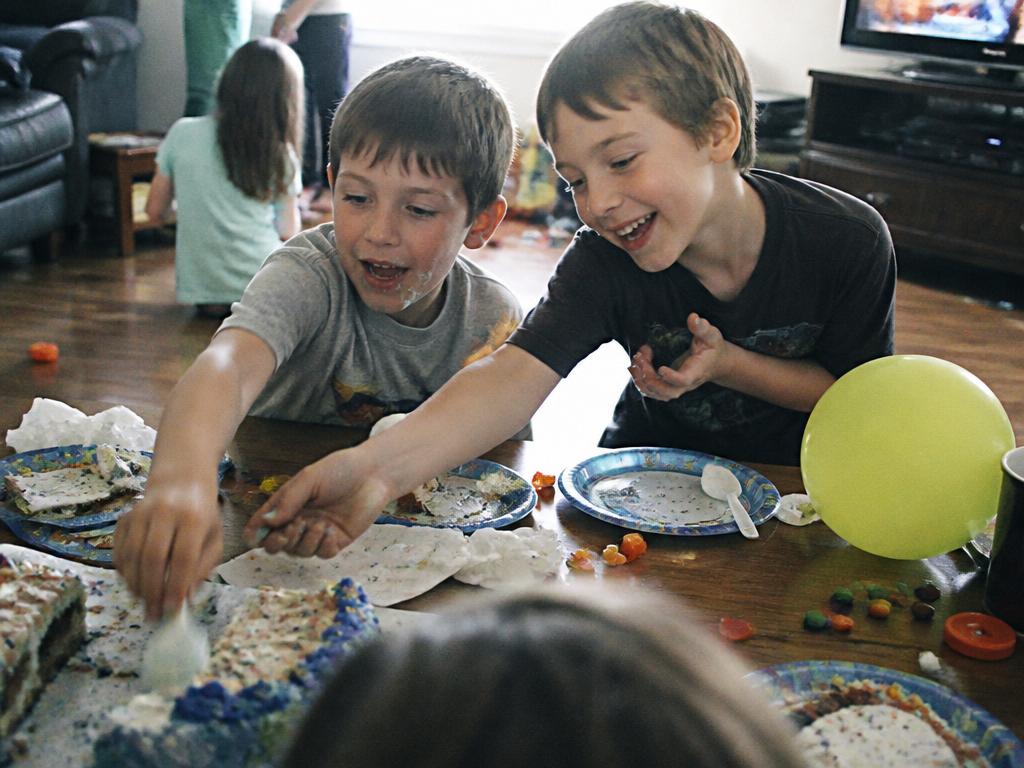
Does sugar make kids hyperactive? Almost every parent has a story about a child bouncing off the walls after cake or candy, and the “sugar high” is treated as obvious common knowledge. Yet this is one of the most thoroughly tested beliefs in all of nutrition, and the research tells a story that runs counter to the conventional wisdom. The gap between what people are certain they see and what the studies find makes this a fascinating case.
The blind-test studies
What makes sugar and hyperactivity unusually well-suited to investigation is that researchers can test it rigorously using blinded experiments. In these studies, neither the parents nor the observers know whether a child has actually consumed sugar, removing the influence of expectation. By comparing behavior when children receive sugar versus a sugar-free substitute, while no one can tell which is which, researchers can isolate the effect of the sugar itself.
The consistent finding from this body of research is striking: sugar has generally not been shown to cause hyperactivity in children. When the studies are blinded so that expectation cannot color the results, the supposed behavioral jolt largely fails to appear. This is not based on a single study but on a fairly substantial line of research that has examined the question from multiple angles.
This is one of those instances where careful experimental design clearly outperforms intuition. The blinded approach is powerful precisely because it strips away the assumptions that everyday observation cannot escape, and what remains does not support the popular sugar-makes-kids-wild belief.
Why parents still see it
If the studies are so consistent, why are so many parents equally certain of the opposite? This is the most interesting part, and the explanation is not that parents are imagining things or lying. It lies in how expectation and context shape perception.
One revealing line of research looked at parental expectations directly. When parents believed their child had consumed sugar, even in situations where the child had not, they tended to rate the child’s behavior as more hyperactive. The belief itself colored the perception. This is a well-documented feature of how human observation works: what we expect to see influences what we think we see.
A few factors help explain the persistent conviction:
- Expectation bias: believing sugar causes hyperactivity makes parents more likely to perceive and attribute it.
- Memorable associations: the times a child was hyper after sweets stick in memory, while the times they were calm after sweets are forgotten.
- Confirmation: each noticed “sugar high” reinforces the belief, which then primes the next observation.
None of this means parents are unreliable people. It means that perception is not a neutral recording device, and that strongly held expectations can shape how behavior is interpreted, especially in lively, unpredictable settings with children.
What’s really going on at the party
If not the sugar, then what explains the genuinely wild behavior that often accompanies sugary occasions? Here the answer is mostly about context, and it is quite intuitive once expectation is set aside.
Think about when children typically consume a lot of sugar: birthday parties, holidays, celebrations, and special events. These occasions are inherently exciting and stimulating, often involving groups of children, games, novelty, disrupted routines, and sometimes less sleep. Any of these factors could plausibly drive energetic, excitable behavior, entirely independent of what is on the snack table.
| Possible cause of the “buzz” | How it fits the evidence |
|---|---|
| The sugar itself | Not supported by blinded studies |
| Exciting party environment | A plausible driver of energetic behavior |
| Groups of kids, games, novelty | Naturally stimulating regardless of sugar |
| Disrupted routines and less sleep | Can affect behavior on their own |
In other words, the setting in which sugar is usually eaten is precisely the kind of setting that revs children up. The sugar and the excitement arrive together, which makes it easy to blame the sugar for an effect the situation is largely producing. Untangling the two is exactly what blinded studies do, and once the sugar is isolated, its role in the chaos shrinks dramatically.
This does not mean sugar is harmless in general or that there is no reason to moderate children’s sugar intake; there are sensible nutritional reasons to be mindful of how much sugar children consume. But those reasons are distinct from the specific claim that sugar makes them hyperactive, which the evidence does not support.
The bottom line
The belief that sugar makes children hyperactive is one of the most-tested ideas in nutrition, and blinded studies have generally not found that sugar causes hyperactivity. Parents nonetheless remain convinced, largely because expectation shapes perception, when people believe a child has had sugar, they tend to see more hyperactivity, even when there was none. The genuinely energetic behavior at parties is better explained by the exciting context: crowds of kids, games, novelty, and disrupted routines, all of which arrive alongside the sugar. There are still good reasons to moderate children’s sugar for general health, but the “sugar high” as a cause of hyperactivity is a myth the evidence does not back.